Relaxed
Coach day trip
The relaxed loop
- Length9 hours
- LunchIncluded
- Pricefrom €113
Your stop on the map
Check out 24 stops
Choose a route, then tap a marker or stop for a note and Google Maps.
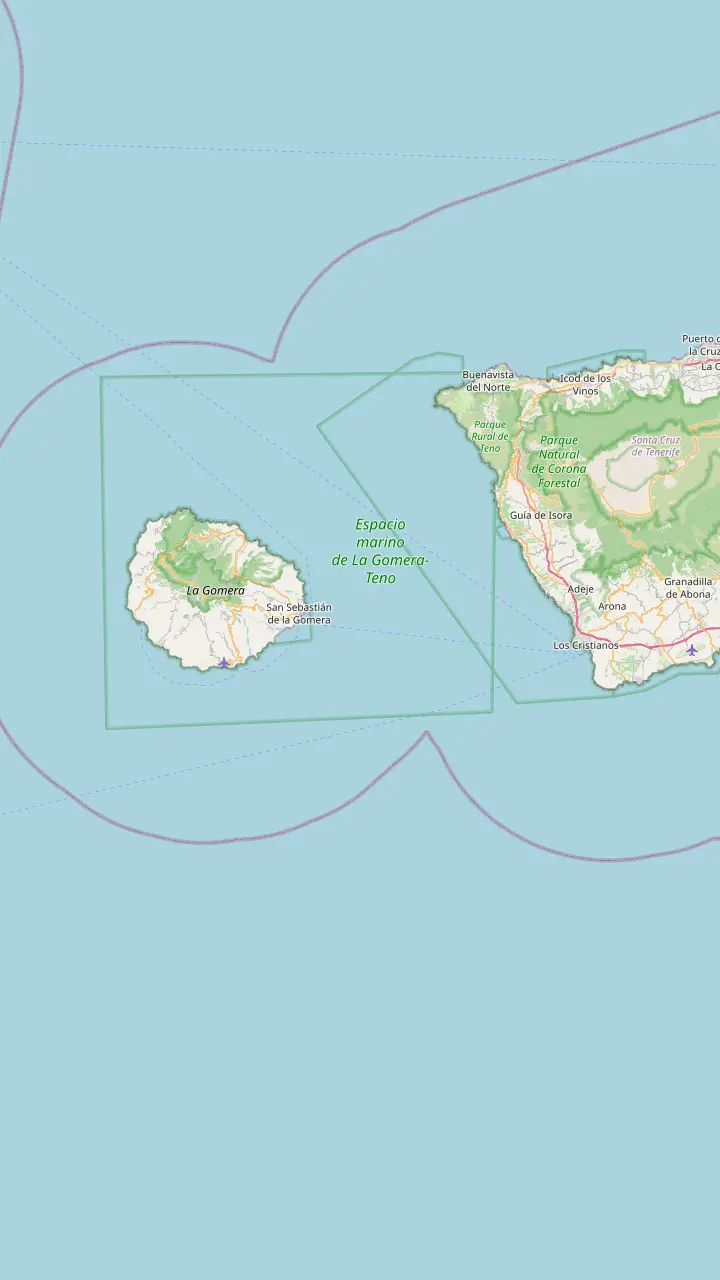
The fast ferry to La Gomera leaves from the port of Los Cristianos and takes 50 minutes.
Google MapsSan Sebastián is the main port of entry to the island and connects with Los Cristianos.
Google MapsThe airport has daily Binter flights to Tenerife Norte and Gran Canaria and no other routes.
Google MapsVueltas is the port of Valle Gran Rey, which the ferry can reach from Los Cristianos in about 1 h 10 min when a direct service exists.
Google MapsPlaya de Santiago is a stop on the inland ferry line between San Sebastián and Valle Gran Rey.
Google Maps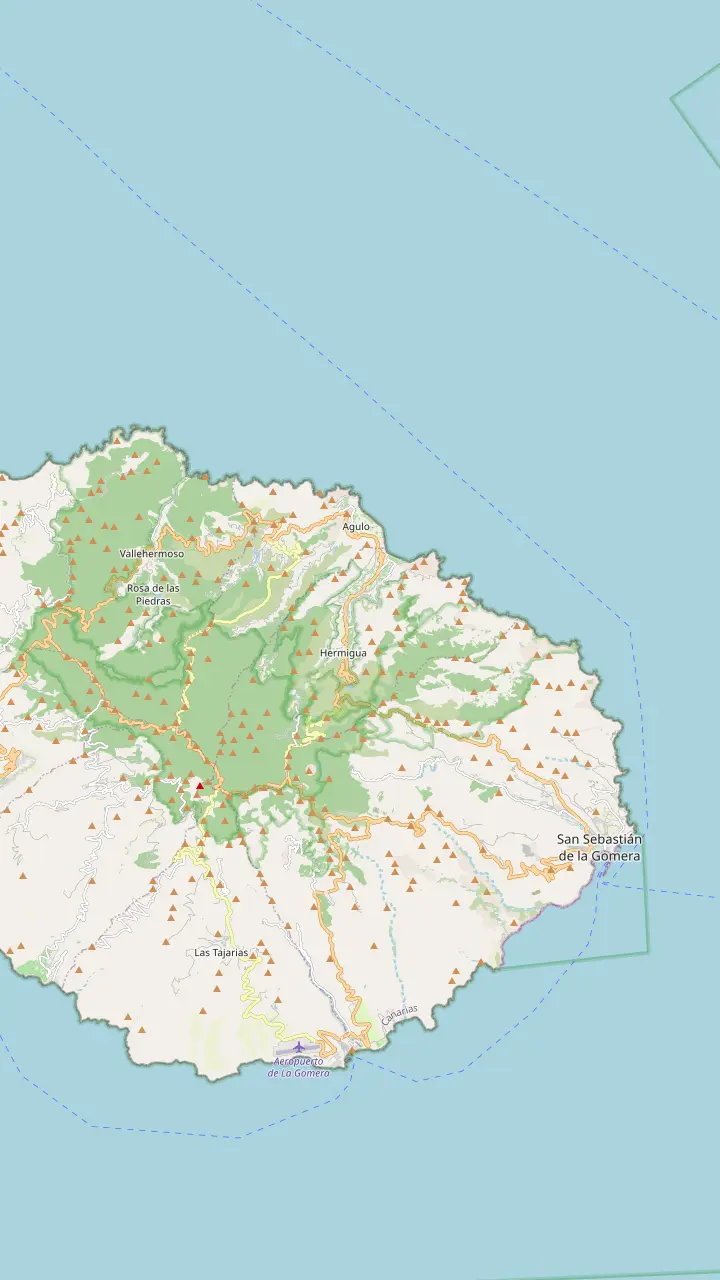
San Sebastián has the Torre del Conde, the church of the Assumption and two quiet urban beaches.
Google MapsHermigua lies barely half an hour by road from San Sebastián on the GM-1.
Google MapsAgulo is known as the Bombón of La Gomera, with white houses and red tile roofs in its old town.
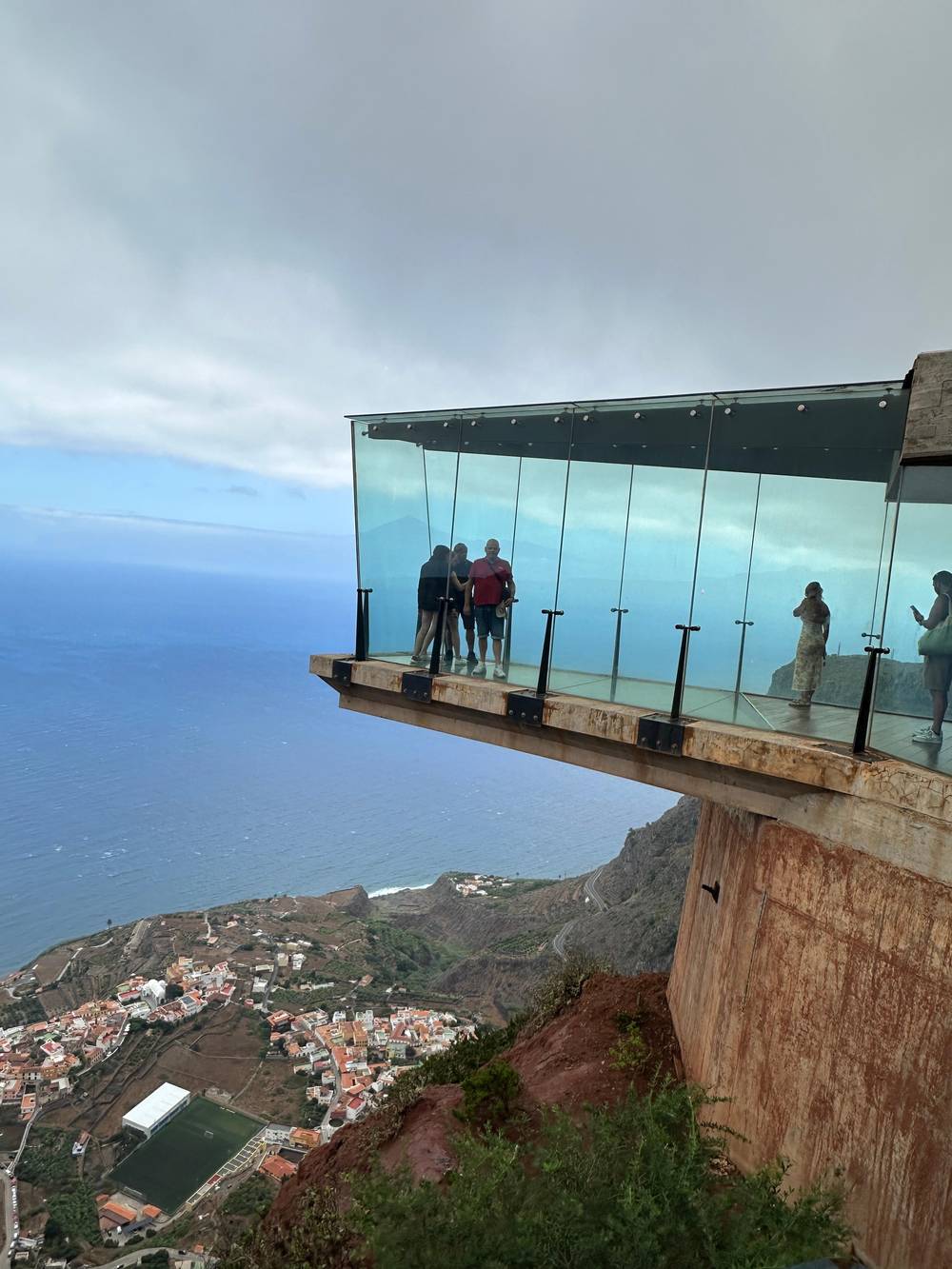
Google MapsThe glass walkway of the Mirador de Abrante lies at more than 600 metres of height and gives a walk of 7 metres.
Google MapsThe visitor centre mixes an exhibition hall, a museum, craft workshops and a botanical garden, and lies outside the national park.
Google MapsLaguna Grande is the recreation area inside Garajonay National Park.
Google MapsThe Alto de Garajonay is the highest point of the island at 1,487 metres.
Google MapsVallehermoso has the largest number of craftspeople of any village on the island.
Google MapsLos Órganos is a volcanic cliff in a protected area that can only be reached by boat.
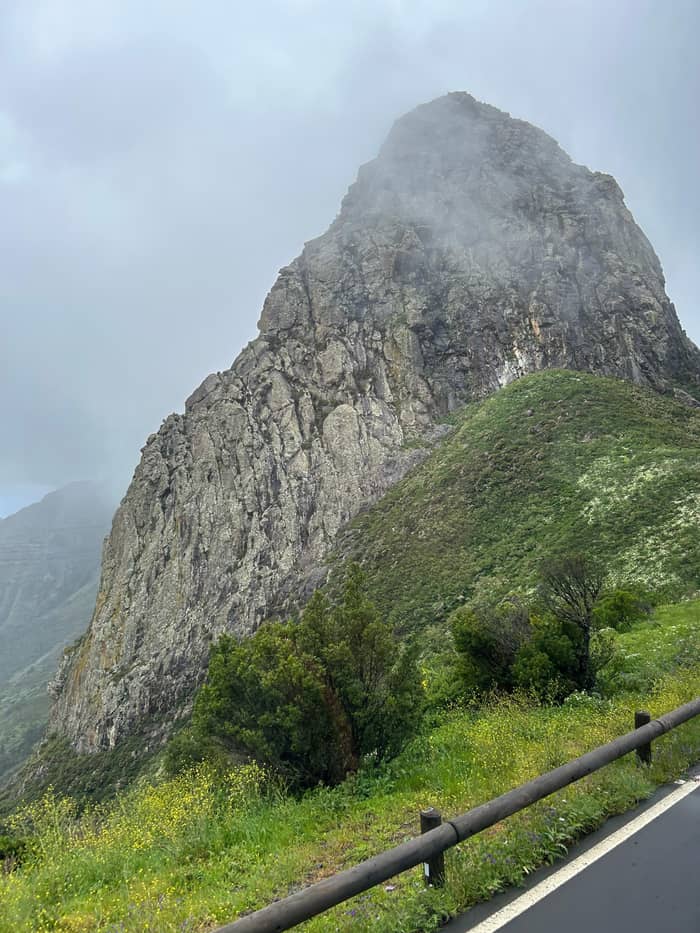
Google MapsThe Roque de Agando is the most emblematic of the volcanic monoliths of the Roques natural monument.
Google Maps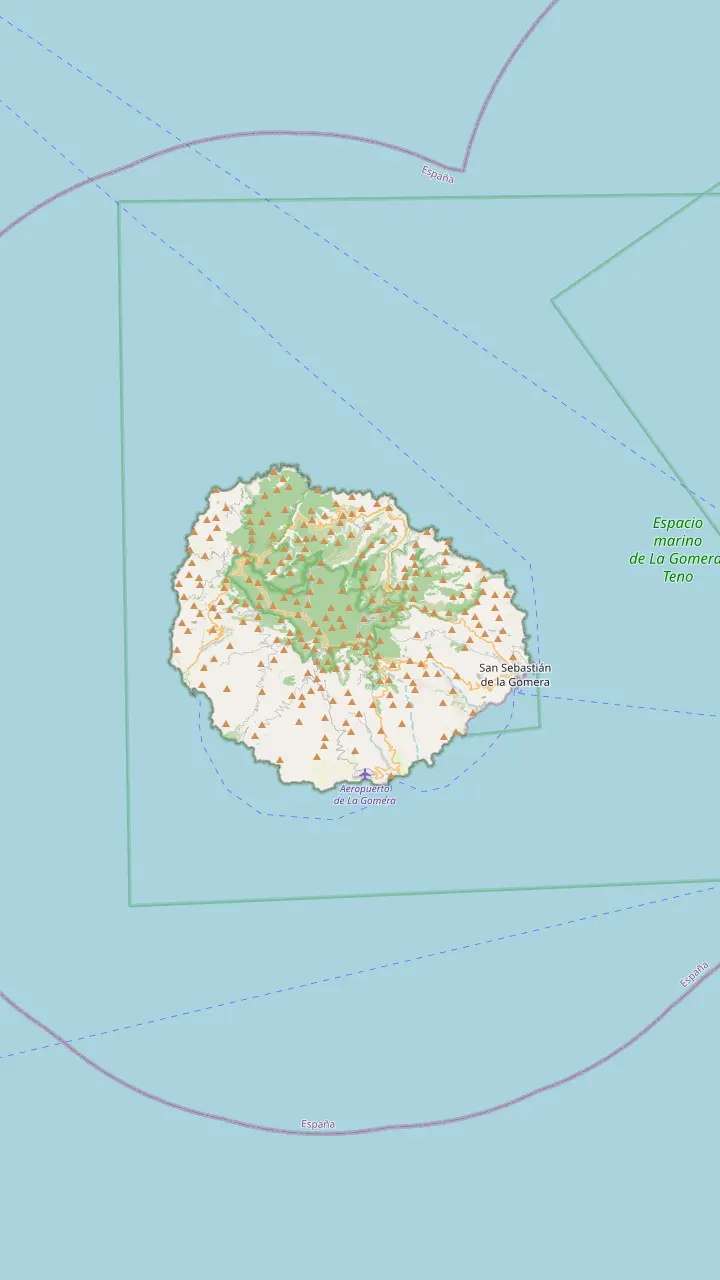
San Sebastián has the Torre del Conde, the church of the Assumption and two quiet urban beaches.
Google MapsThe Roque de Agando is the most emblematic of the volcanic monoliths of the Roques natural monument.
Google MapsFrom the Mirador de Igualero visitors can see the monument to the Silbo Gomero.
Google MapsChipude lies 15 minutes by car from El Cercado.
Google MapsEl Cercado has traditional pottery workshops and the Las Loceras interpretation centre.
Google MapsThe Mirador del Palmarejo was designed by the artist César Manrique and looks over the palm grove of Valle Gran Rey.
Google MapsValle Gran Rey opens onto beaches of black sand, and the island site praises its sunsets.
Google MapsFrom the Mirador del Santo the hamlet of Taguluche is seen at the bottom of the ravine, with one of the best sunsets on the island.
Google MapsThe Alto de Garajonay is the highest point of the island at 1,487 metres.
Google MapsMap data from © OpenStreetMap contributors
A map and a table of the stops on the island loop, what each village gives you, which viewpoints are worth the bend in the road and why the basalt organ pipes are seen from the sea.
Editorial team, lagomeratour.click · Updated November 23, 2026 · 8 min reading time
Basics
La Gomera tourist attractions are spread around a small, almost round island, and most of them can be seen on one loop. The island board calls La Gomera the second smallest island of the archipelago,6 and it counts 35 official viewpoints in the island's network.5 The map shows the loop in parts: the harbours that link the island to Tenerife, the north with the forest, and the south and west.
The loop works because the villages sit in valleys that open to the coast, while the viewpoints and the forest sit on the high ridges between those valleys. A coach or a jeep tour joins those parts, crossing the high ground of the island on the way, so a single vehicle can show both the shoreline and the cloud forest. The coach day sold on this site covers Hermigua, El Cedro, Garajonay, the villages of Chipude and El Cercado, Roque de Agando and the capital in 9 hours.
If you drive yourself, the island board recommends driving routes for people short of time and starts one of them at San Sebastián's tourist office.7 That is a good habit even for a coach traveller on a tight schedule, because a printed map and a talk with the office at the harbour take away the guesswork. The rest of this page follows the loop from the capital through the north and back along the south and west.
Stop by stop
| Stop | What it gives | Road or sea time |
|---|---|---|
| San Sebastián | The Torre del Conde and the Assumption church.1 | Starting point |
| Hermigua | A museum, an ethnographic park and the Pescante.13 | Half an hour from the capital2 |
| Agulo | Old town and the Roque Blanco monument.16,17 | A few minutes from Hermigua8 |
| Mirador de Abrante | A glass walkway at more than 600 metres.3 | In Agulo |
| Roque de Agando | The emblematic volcanic monolith.22 | On the way back to the capital11 |
| El Cercado | Pottery workshops and the Las Loceras centre.23 | 15 minutes to Chipude21 |
| Los Órganos | A volcanic cliff seen from the water.4 | Boat only |
Times follow the island board's driving routes and are indications, not a timetable.2
San Sebastián de La Gomera is the capital and the port where the ferry from Tenerife arrives. The board lists the Torre del Conde, the church of the Assumption and two quiet urban beaches,1 and the Casa de Colón can be visited as a museum.12 From the capital, the road north reaches Hermigua in barely half an hour on the GM-1,2 and the villages that follow are close to each other, so the northern stops fit into a single relaxed morning, with a coffee between each.
Hermigua has a green valley and a history of boats. The board lists the Ethnographic Museum, the Los Telares Ethnographic Park and the natural pools at the Pescante.13 The Pescante was an old pier that finished construction in 1908 and fell out of use in the late 1950s.14 The board adds that the temperature in Hermigua rarely falls below 18 degrees in winter or rises above 27 on the hottest summer days.15
Agulo lies a few minutes by car from Hermigua, and the board calls it the Bombón of La Gomera.8 Its old town has narrow cobbled streets, white houses and red tile roofs,16 and the Roque Blanco natural monument near Abrante covers 27 hectares.17 The board says the largest juniper wood in the Canary Islands grows between Vallehermoso and Agulo,18 which makes the stretch pleasant for anyone who likes trees and open ground.
Minutes on the move
The Mirador de Abrante in Agulo is a viewpoint that rewards a photograph. The board says its glass walkway lies at more than 600 metres of height and allows a walk of 7 metres,3,28 and that it was built in 2014.29 There is a restaurant inside the glazed building,30 and if the clouds allow, the Teide and the coasts of Tenerife appear on the horizon.31 Arrive early if you want to walk out before the tour groups.
The Mirador del Palmarejo in Valle Gran Rey was designed by the Canarian artist César Manrique and looks over the palm grove of the valley.32 The Mirador del Santo near Arure shows the hamlet of Taguluche at the bottom of the ravine, with one of the best sunsets on the island, according to the board.33 Both sit on the western leg of the loop, so they suit the end of a day that has started in the north.
At Los Roques the island offers a different kind of view. The board says the viewpoint looks over huge blocks of rock that are remains of old volcanic chimneys,34 and that the Roque de Agando is the most emblematic of the volcanic monoliths of the natural monument.22 At the foot of Agando stands a monument to the dead of the fire of 1984.35 The island board suggests stopping there on the way back to San Sebastián.11
Pick your stops
Tell us your top priority and the best-fitting stop appears.
If I want a photograph from the sky
Mirador de Abrante
The glass walkway lies at more than 600 metres.3
If I want old streets and pastries
Agulo
The old town has cobbled streets and white houses.16
If I want beaches and a sunset
Valle Gran Rey
Black sand beaches and one of the most beautiful sunsets in Europe.24,25
If I want pottery and the whistle
El Cercado and Igualero
The board lists pottery workshops and the Silbo monument.23,26
If I want the organ pipes
A boat trip
Los Órganos can only be reached by boat.4
Pick a way round
Relaxed
The relaxed loop
Active
Faster between stops
Guided
Villages and viewpoints
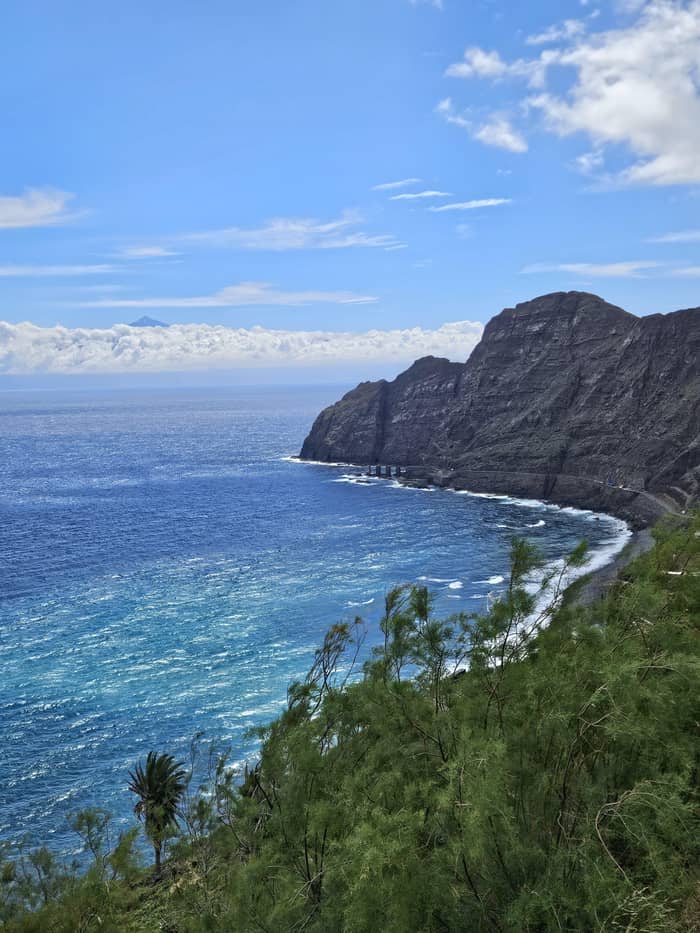
Los Órganos is a stop the road does not reach. The island board describes it as a volcanic cliff in a protected natural area that can only be reached by boat,4 and as a spectacular volcanic cliff shaped like giant tubes, like a huge stone organ, that runs down into the ocean.27 A Los Órganos tour is therefore a boat trip along the coast, not a coach stop, and it is worth planning separately from a road loop.
The board's routes for cruise passengers include an excursion to Los Órganos,46 so the cliff is on the official list of things to do. The nearest road village is Vallehermoso, whose coast the cliff belongs to. If a tour on this site mentions the cliff, read the listing carefully to see whether it passes the cliffs by boat or only describes them, since coach and jeep day trips from Tenerife follow the roads.
Boat trips on the island are better known for sea life. The board says up to 21 species of cetaceans have been documented in the waters around La Gomera and that the sea around the island is the first Whale Heritage stretch in Europe, declared by the World Cetacean Alliance.47,48 Whale and dolphin trips have their own specialists, so this site does not sell them, but they are a sensible way to pair the cliffs with a morning at sea.
Compare the days
Enter the party size and set the coach against the jeep.
Choose from 3 options
Enter the party size and set the coach against the jeep.
≈
View≈
View≈
ViewCurrency conversion uses the ECB reference rate on GetYourGuide from-prices. The exact price is displayed when you book.
A day in the north
The capital
Start at the tourist office and visit the Torre del Conde and the Casa de Colón.7
The valley
Barely half an hour away on the GM-1.2
The old town
A few minutes from Hermigua, on foot through cobbled streets.8
The glass floor
The island board calls it the only glass-floored viewpoint of the island, at more than 600 metres.9
The forest
A visitor centre with a museum and a botanical garden.10
The way back
A stop to see the volcanic domes before San Sebastián.11
The south and west of the island have a different mood. The board describes Vallehermoso, the largest municipality, with a third of Garajonay National Park inside it,49 and it describes the church of La Candelaria in Chipude as one of the oldest in the archipelago, with origins in the 16th century.50 Chipude lies 15 minutes by car from El Cercado.21 Both villages sit above the coast, away from the beaches.
El Cercado is the place for pottery. The board says visitors can see traditional pottery workshops and the Las Loceras interpretation centre,23 where the craft is made by hand without a wheel.51 From the Mirador de Igualero you can see the monument to the Silbo Gomero.26 Together those stops make a small cultural circuit that fits between the forest and the coast on a day with a guide.
Valle Gran Rey lies in a large ravine that opens onto beaches of black sand and blue water,24 and the board credits the valley with the island's largest stock of tourist accommodation.52 It also warns that the sea at Playa del Inglés is often strong, so swimmers have to be careful.53 The sunsets are the reward for staying late, and the board says the valley boasts one of the loveliest in Europe.25
Video
Travel Obscurer on YouTube · Until you tap play, no video is loaded.
Los Órganos is an impressive volcanic cliff in the form of gigantic tubes.
Before you set out
La Gomera activities fall into a few families, and the board covers all of them. Walking is the main one, with 600-plus kilometres of footpaths,54 and cycling has its own routes. Sea life is another: dolphin and whale trips leave from Vueltas, the port of Valle Gran Rey, and on some days from Playa de Santiago, according to the board.55 Beaches, food and crafts fill the gaps between the viewpoints.
The cruise-passenger routes of the board are a useful menu, even for visitors who are not on a ship. They list 12 routes for people with a few hours,56 among them a viewpoints route through Los Roques, El Bailadero, El Rejo and Manaderos.57 Reading that list shows how the island's own tourist board splits the loop into short outings, and it is a good template for building your own day if you arrive by ferry with limited time.
Gentler activities suit a family day. The Juego de Bolas visitor centre has an exhibition hall, a museum, craft workshops and a botanical garden,10 and the Vallehermoso marine park has fresh-water pools for swimming without waves.58 The Botanical Garden of the Discovery in Vallehermoso holds plants from the five continents.59 None of these needs a guide, and each one is a good fallback when the cloud sits on the ridge.
The coach day on this site runs for 9 hours with lunch and starts from €113, and its stops run from Hermigua and the forest of El Cedro to the capital, with a Silbo demonstration over the meal. A guided tour with a ferry and lunch of 10 hours lists San Sebastián, Hermigua, Agulo for lunch and Garajonay National Park, from €113. Those routes cover much of the same ground.
The full-day jeep safari from Arona starts from €154 and has live guides in 7 languages, and the VIP tour by 4-wheel drive of 10 hours starts from €170. A jeep listing offers another way to cover the same ground, and the coach-or-jeep choice is compared elsewhere on this site. A listing for a small-group tour on the island runs for 5 hours, with Garajonay and Roque de Agando among its stops as well as Chipude, Igualero and El Cercado.
Distances on the island are short, but the roads are slow. From the airport the capital is 35 km and 50 minutes away by road, while Valle Gran Rey is 45 km and 60 minutes away.20 The board counts 8 interurban bus lines for travellers on their own.44 Plan a loop that suits your pace, accept that a day covers only part of the island, and save the south and west for another visit with more time.
FAQ
The island board says it takes barely half an hour on the GM-1.2
The board says the cliff in the Vallehermoso coast can only be reached by boat.4
The board says visitors can see pottery workshops and the Las Loceras centre there.23
The board says the viewpoint has a monument dedicated to the Silbo Gomero.26
It says the valley boasts one of the most beautiful sunsets in Europe.25
The coach listing runs for 9 hours and the guided ferry tour for 10 hours.
Sources
Planning La Gomera from Tenerife? Ask a real person here.